
Debating Kalam: Dustin’s Response
Dustin and I agreed to exchange opening statements before the debate, so I’m going to be posing the text of the first half of the debate we had on Wednesday. My previous post has my opening statement, this post has his response, and the next one will have my response to his response. He didn’t end up reading his speech exactly as he prepared it, but hit on pretty much all the same points and I didn’t have to make many changes to my prepared response.
Although I don’t think it mattered much in this debate, if you are going to be arguing against Kalam in a debate, do not agree to exchange opening statements. It helps your opponent much more than it helps you. If you took the time to prepare, you should be pretty familiar with all the arguments in favor of Kalam. But if your opening statement contains objections that are difficult to answer, giving it to your opponent before the debate might allow him or her to come up with something that sounds like an adequate response. It’s a little harder to come up with bullshit that doesn’t sound like bullshit in the middle of a debate.
Anyway, here’s Dustin’s speech:
The kalam cosmological argument, though it pretends to be based on scientific principles, is nevertheless riddled with flaws. Allow me to restate the argument:
- The first premise is that everything that begins to exist has a cause.
- The second premise is that the universe began to exist.
- The conclusion is that the universe was caused, and this cause is known as God.
The argument is indeed valid, but the problem is that all of the premises can indeed be rejected, most notably the first premise, and even accepting the premises, the conclusion does not necessarily demonstrate that a God defined in the traditional senses exists.
Does everything that begins to exist have a cause? Modern physics denies this premise. Many events at the subatomic level are completely random and occur without a cause. The energy fluctuations that occur in vacuums are just one example of an uncaused event. My opponent argues that we never see macroscopic entities like dogs, cats, and hamburgers randomly pop into existence, and that is correct. That is because these uncaused events only occur on a subatomic level, where the science of quantum mechanics applies. Macroscopic objects like dogs and cats, of course, are not subject to these fluctuations for a variety of proposed reasons, of which the most prominent is decoherence. To use another example, it is well-known that quantum mechanics shows that photons can behave in ways similar to particles and waves, depending on the experiment. But no one then argues that wave-particle duality is impossible because we never see cats and dogs behaving as both particles and waves. If you shoot a cat toward a slit in the double slit experiment, it will not create an interference pattern characteristic of a wave, but instead a particle-like and flustered cat imprint in one spot on the wall! My opponent has also claimed that denying causality would impede science, but this is clearly not the case if one gives only a cursory glance at the flourishing fields of cosmology, quantum physics, and other areas of theoretical physics that accept uncaused events. Because the events are uncaused, scientists can't say with deterministic certainty whether an event will occur, but he or she can use statistical analysis to get an idea of the probability. Hence, science can still be practiced even without assuming every event is caused, contrary to the claims of my opponent. The idea that uncaused events exist is so well demonstrated that the kalam cosmological's first premise is highly unlikely to be true, even if it does seem intuitively true to those of us who live in the macroscopic world. Physics, unfortunately, is not intuitive.
Given the seemingly insurmountable problems with the first premise, it is not necessary to also deny the second premise. If the first premise is incorrect, the whole argument fails. As such I can accept that the universe began to exist with ease. Even so, I will make a few general comments about ways in which the second premise could potentially be incorrect, and rebut some of the philosophical justifications made for the premise.
One of the reasons given for the premise that the universe began to exist is that an actual infinite cannot exist. That is, if the universe always existed, its eternal extension backwards through time would be an actual infinite. This is not necessarily true, though. It is important to note that the argument does not deny potential infinites. The universe can continue to exist throughout the future indefinitely, but this is not an actual infinity. It only means that the universe's existence is limitless. But if this applies to the universe's future, it can also apply to its past. If the universe never began, it would be limitless, not infinite.
Many appeals are made to the weirdness that results when adding and subtracting different infinite sets in the Hilbert Hotel example, but merely because it leads to weird results doesn't mean an actual infinite is impossible. Subtract all odd numbers from all even numbers, and you are left with the result of infinity. (That is, infinity minus infinity equals infinity.) But subtract all numbers greater than 3 from all positive numbers, and you are left with 3. (That is, infinity minus infinity equals three.) This is certainly weird! It is also weird that light behaves like a wave and a particle. But the reason it is weird is only because there are different classes of the infinite. It is only confusing if you think of infinity as a single number, not unlike 3, and not a class of various sets of numbers containing infinite members. It is also important to remember that physicists are not claiming that the number infinity exists. Numbers are only tools used to describe reality, not existing entities in their own right. Thus, it isn't that the number infinity exists, but that the universe has existed for an infinite number of years. There is nothing problematic about saying that. But as I noted previously, it is more proper to say the universe has no limit forward or backward in time. As such, it seems the philosophical justifications in support of this premise are not unquestionable. In the end, a priori arguments such as these should not decide the case of whether infinity exists---we should let reality and empirical evidence decide.
What does the empirical evidence say concerning the matter of a universe beginning to exist? My opponent is correct to point out that the universe implies a beginning in time. This is because observations of the cosmic microwave background radiation, the expansion of the universe, and so on show that the universe was once condensed into a single point. The mathematics show the laws of physics breaking down at the point of the Big Bang known as the singularity. Time and space are thus created at that point. The evidence listed in support of the Big Bang is correct, and I will not question it. However, while it seems clear our own universe had a beginning in time (and time itself had a beginning), it doesn't necessarily imply that our universe was caused by God. Before the Big Bang, physicists cannot say what happened. God, in fact, is the least likely explanation, and modern physicists do not seriously entertain that idea. Because uncaused events are common at the subatomic level, and the universe was once reduced to a subatomic point, we can explain the creation of the universe as an uncaused event. This would certainly be the most parsimonious explanation. However, physical models of the universe are not complete; we are working with lots of missing puzzle pieces. For example, relativity and quantum mechanics are not consistent with each other. As such, some cosmological theories have been proposed that hypothesize extra dimensions, multiple universes, and other fantastic elements in a manner that renders relativity consistent with quantum mechanics. These are generally known as String Theory, M-Theory, and a host of other names. Some propose that there are multiple universes, with our own universe being a single bud among an endless landscape of possibilities. While these are not quite empirically supported, they at least have the advantage over conjectures about God in that they attempt to render the mathematics consistent! But the most reasonable stance to take concerning the creation of the universe, given our current knowledge, is to admit we don't know. These ideas also show that the cause of the universe may not have been God, but budding from other multiverses.
It should also be said that even if the argument were valid, it would not demonstrate that God exists in the traditional sense of the word. All the argument demonstrates, if true, is that the universe was caused by something. There is no additional evidence as to what attributes this cause may have (or even that it was the first cause), much less that it has the qualities of a personal God, like the ability to think and the characteristics of omnipotence and moral perfection. It strikes me that if the argument succeeds, it does so only by relying on the elusiveness of properly defining what God is. It is not unlike proving that a plastic object used to heat bread exists on my kitchen counter, and then proclaiming that this object is God. No, it is not a God, but a toaster. And to the kalam argument I can respond that, no, it is not a God, but a cause, and this cause may very well be what string theorists allude to when speaking of our universe budding from additional universes. My opponent argues that the cause must be immaterial, but presumably if the universe arose out of nothing (as in a vacuum fluctuation or sea of virtual particles), then in a sense we can call that immaterial, but it is not a god. The attempt to argue that the cause is personal and capable of thought is likewise faulty. Big Bang cosmology only demonstrates that the current laws of physics as we know them break down at the time of the big bang. My opponent argues that there cannot be a scientific explanation since there was no natural world before the Big Bang, and therefore it cannot be accounted for by laws operating on initial conditions. He then concludes that the cause is best explained in terms of agents and volition. But there are plenty of other possibilities that I've mentioned, including the idea that our universe is one of many in a multiverse, or that there was nothing prior to the Big Bang and our universe simply resulted from a quantum vacuum fluctuation. These are possibilities that are taken seriously by physicists that do not require characteristics like agency, and hence my opponent is simply wrong to think the physics points to agency as the only reasonable cause. In fact, it is the most unreasonable cause of the three, because in science we generally observe that agency results from brain function, and there is no model for agency existing in some immaterial sense. Likewise, vacuum fluctuations are already known to exist so that explanation in particular is more parsimonious than any God hypothesis.
Debating Kalam
Last Wednesday I took part in debate night, where a bunch of us St. Louis atheists get together and debate various things. It was an interesting experience since this is the first semi-serious debate I have done, and because I was the one arguing for the existence of God. My opponent was Dustin (Saint Gasoline) and the topic was William Lane Craig’s Kalam Cosmological Argument.
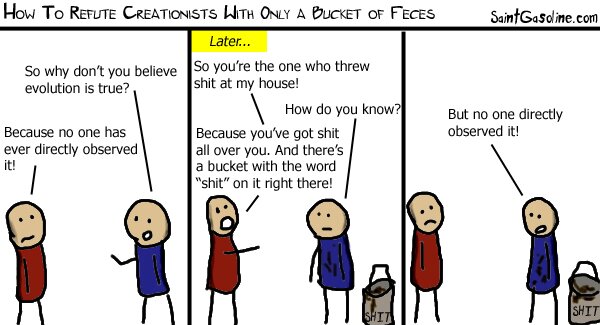
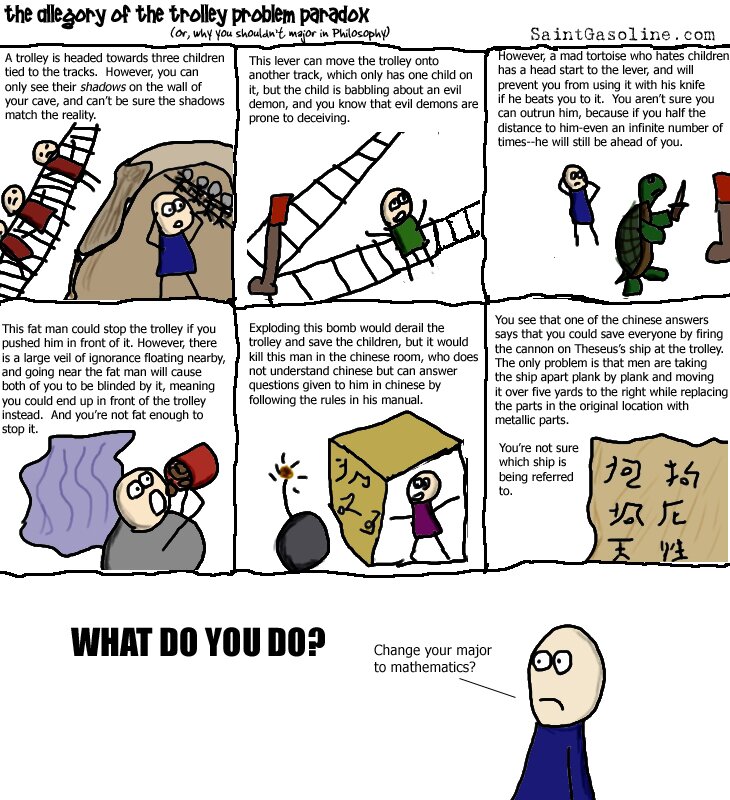
Since I didn’t think Kalam was a sound argument and had a long list of things I thought was wrong with it, I figured I should do some research to see how Craig would respond to those objections. I didn’t want to just concede the debate as soon as Dustin pointed out something I thought was a fatal flaw in Kalam. And I figured that I couldn’t get away with just evading or pretending to answer one of his criticisms since he’s pretty good with philosophy and great at lampooning absurdities:
So I decided to read a lot of the published work on Kalam, both pro and con. I tried to put myself in the shoes of a believer and focus not on finding fault with the argument but on finding the best arguments for Kalam and finding the best responses to arguments against it. I think I was able to do a pretty good job of this, perhaps because I would have no problem believing in God if I actually thought there were solid arguments for his existence. It was a pretty weird experience though. After reading many of Craig’s responses to objections to the argument, whenever I read a new objection I would feel sure that Craig would have a good response. And sure enough, he did, or at least one that seemed good when you were predisposed in favor of Kalam. Eventually though, I came across serious objections that neither I nor Craig seemed to have good answers to. Fortunately for my chances in the debate, Craig had reasonable responses to many of the most common objections to Kalam.
Does the fact that Craig has good answers to some of the most common objections mean they are bad objections? Not necessarily. If someone does not provide any support for the premises of the Kalam argument, then a reasonable objection is to say that you haven’t seen any reason to think that either premise is true. If someone provides some arguments for the premises, but those arguments have flaws, it’s perfectly reasonable to point out those flaws. It may be possible for a theist to get around some of those flaws by making a more complex version of the argument that has new and different flaws, but that doesn’t make the original objections bad. However, I think it is a big mistake for people debating William Lane Craig to focus on the more basic objections. Craig can respond by quickly rebutting these objections and can then use the rest of his time to make even more arguments in favor of Kalam. That’s what I hoped to do in the debate, and I think this strategy was pretty successful.
So it’s important for anyone debating Kalam to not only know a lot of objections, but to know how a proponent of Kalam will likely respond. Since Kalam is one of the most popular arguments for the existence of God, I think that anyone wanting to debate the existence of God should have a good understanding of the arguments for Kalam.
I’m planning on doing a series of posts which will hopefully give people a better idea of what to expect when debating Kalam. But before I get into arguments against Kalam, I’m going to post the opening speech I prepared for the debate so you can see Kalam at its strongest (or at least my attempt to present it as strongly as possible). Here’s the speech:
The question of whether God exists is one of the most important questions we will ever have to answer. The decision we reach has the potential to not only affect how we live our lives, but what will happen to us after we die. For that reason, I think that all arguments for and against God’s existence should be exposed to intense scrutiny. My opponent tonight is an atheist writer and cartoonist who has previously written on, and debated, the Kalam cosmological argument. I expect him to have a long list of objections, which I will do my best to answer. I believe that the Kalam cosmological argument will withstand his criticisms, but you will have to judge that for yourselves.
The Kalam cosmological argument is actually remarkably simple. Its first premise is that everything that begins to exist has a cause. Its second premise is that the universe began to exist. Therefore, we conclude that the universe has a cause. This is a valid argument, which means that if the premises are true, the conclusion must be true. So an atheist must reject at least one of these premises if he wants to avoid believing that the universe had a creator.
I will begin by talking about why I think that the universe must have had a beginning. One argument in favor of this is as follows: Premise 1: An actual infinity cannot exist, Premise 2: an infinite temporal regress of events would be an actual infinity. Therefore an infinite temporal regress cannot occur. Something may be potentially infinite; you may be able to keep dividing it, or adding to it. But you can never reach the point where you actually have an infinite quantity of something. While the concept of an actual infinity can be expressed mathematically, as in Cantor’s system of transfinite arithmetic, mathematicians Kasner and Newman have noted that “’Existence’ in the mathematical sense is wholly different from the existence of objects in the physical world.” In the words of the influential mathematician David Hilbert, “The infinite is nowhere to be found in reality. It neither exists in nature nor provides a legitimate basis for rational thought… The role that remains for the infinite to play is solely that of an idea.”
For the existence of an actual infinity would have absurd consequences. Imagine a book whose first page is 1/2 inch thick, whose second page is 1/4 thick, etc. Although there is no last page, the book is of finite thickness and each page is still a finite number of pages away from the first page. Now take the book, close it, turn it over and lift up the back cover. There is nothing there to see! Now imagine trying to touch the last page. The problem is that after any page, there are infinitely more after it. So if you are able to touch any page at all, your hand must have somehow already penetrated infinitely many pages. This example demonstrates the absurdities inherent in having actual infinities exist in reality.
This point is further emphasized by the example of Hilbert’s Hotel. In a hotel of infinitely many rooms and with no vacancies, you could still find room for infinitely many new guests merely by shifting the current guests to the even numbered rooms and putting the new guests in the odd-numbered rooms (assigning the old guests to the rooms that are twice their old room number). And you could even have infinitely many guests check out (all those in odd numbered rooms) and still have a full hotel merely by shifting people to rooms that were half their old room number. But if the infinitely many guests that leave are all those in rooms numbered above 3, then the hotel would become virtually empty and there would be no way to shift the guests around to avoid this. Thus you can have the same number of people leave, and get radically different results. Can anyone genuinely believe that such an absurd hotel could exist in reality?!
And any infinite temporal regress must be an actual infinity because every event takes a certain amount of time, for an infinitely slow event would actually be a changeless state. Regardless of how long each event took, infinitely many events would have taken place given an infinite amount of time. Since an actual infinity cannot exist and an infinite temporal regress would be an actual infinity, the universe must have had a beginning.
There is also ample empirical evidence that the universe had a beginning. Over the last century, scientific discoveries such as cosmic microwave background radiation and the cosmological redshift have provided strong evidence in favor of the Big Bang model. We now know that the universe is expanding, and if you were to travel back in time, you would see the universe getting smaller and smaller. In the words of physicist P.C.W. Davies, “If we extrapolate this prediction to its extreme, we reach a point when all distances in the universe have shrunk to zero. An initial cosmological singularity therefore forms a past temporal extremity to the universe. …the big bang represents the creation event; the creation not only of all the matter and energy in the universe, but also of spacetime itself.” Under the Friedmann-Lemaitre model, which is the standard Big Bang model, matter and time originated ex nihilo a finite amount of time ago at the initial cosmological singularity. There have been countless attempts over the years to avoid the inescapable conclusion that the universe began to exist. The steady state model was proposed and then discarded. The oscillating universe model was proposed and then discarded. There have always been, and will continue to be, plenty of fanciful speculations, but none of them are realistic. Time does not permit me to explain the problems with every alternative ever conceived, but I would be happy to explain the problems I see with any alternatives that my opponent thinks are viable. Since there is no plausible way in which the universe could have existed for eternity and because of the strong philosophical arguments against a beginningless universe, we reach the conclusion that the universe began to exist.
Of course an atheist could still argue that maybe there’s some a-causal way in which the universe could have come about. To do this, he must argue that the entire universe just suddenly appeared for no reason whatsoever. But no one seriously believes that things like dogs and sports cars can just pop into existence without a cause. However, if things could come into existence from nothing, why just universes, why not airplanes, hamburgers and construction workers? Why is nothingness so discriminatory? How can there be some property of nothingness that favors universes, since nothingness has no properties? And believing that things do not need causal explanations would wreak havoc on the sciences. If scientists had simply assumed that things could appear uncaused out of nothing, there would not have been such a wealth of groundbreaking scientific discoveries over the last century. Scientists could always label something uncaused and never have to search for a causal explanation for it. We should be very careful not to cut off the search for explanations too soon.
While I do not think the universe could be eternal for the philosophical and scientific reasons I listed, if all my philosophical arguments turn out to be misguided and our current understanding of physics turns out to be merely a mythic narrative with no basis in reality, we should obviously reconsider. But barring this, I think we need to go with what seems like the only reasonable explanation, that some entity created the universe a finite amount of time ago.
Once we realize that there must be a creator of the universe, the next step is to try to figure out what properties this creator possesses. Since everything that begins to exist has a cause, we have (by contraposition) that the uncaused creator did not ever begin toexist. Since he is the creator of all matter, he must himself be immaterial. He must also be unbelievably powerful since he brought all matter, energy, and even space-time itself into existence without any material cause. There is also good reason to think that this cause is personal. There are two types of causal explanations: scientific explanations in terms of laws and initial conditions, and personal explanations in terms of someone’s will. For example, if you asked, “Why is the kettle boiling?”, I could say that heat from the burner is being conducted through the metal bottom of the kettle to the water, causing the water molecules to vibrate so violently that they break the surface tension of the water and escape in the form of steam, or I could say that I put the water on because I wanted some tea. In this case, both are legitimate explanations, though some people may look at me a little funny if I responded with the former. But with the universe, there cannot be a scientific explanation since there was no natural world before it came into being and therefore it cannot be accounted for by laws operating on initial conditions. So the most plausible explanation is in terms of an agent and their volitions. Therefore, we have good evidence for an uncaused personal creator of the universe who is beginningless, immaterial, and incredibly powerful. This is what we mean by God. Of course this does not prove that the Christian conception of God is correct while the Muslim one is false. For that we need to look at things like the historical evidence for Jesus’ resurrection, and the countless miracles that have taken place over the years. But if sound, the Kalam cosmological argument invalidates atheism. I urge you to carefully consider this argument, for the conclusions you reach tonight may have consequences far greater than you realize. Thank you.
Why I Care so Much About Gay Rights
The main reason why I support gay rights is because there is no good reason to deny gay people the same rights that the rest of us enjoy. I’ve heard all kinds of arguments against gay rights, but none of them make any sense. That is why I support gay rights. But there’s also a much more personal reason, and that’s what I’d like to share in this post.
My mother grew up in a large family in western Maryland. She had six siblings: five sisters and one brother. They were very poor growing up, and everyone had to wear hand-me-down clothes and shoes, regardless of whether or not they fit. My grandmother was a homemaker and my grandfather never completed elementary school and made a living helping to build houses. According to my mother, they were also sometimes emotionally abusive and inflicted wounds on her that she has only recently been able to deal with.
But her brother rose above all of that and went on to become a very successful doctor. He was also gay. I can only imagine how hard it must have been to hide who he really was for many years. But he was fortunate that when he did come out, his family was still very supportive of him.
He was also one of the kindest men I have ever met. He loved spending time with me and I loved spending time with him. He would show me how to do little art projects and take me camping. I remember one of our camping trips when I was a few years old and I peed in the bed in his RV. I was incredibly embarrassed, but he reacted with nothing but compassion. He also paid for some of us to go on a cruise of Hawaii with him and his spouse. While I was only three or four at the time, I still remember a couple things from that trip. I remember being absolutely disgusted by poi and I remember how one night a volcano erupted and lit up the night sky with an explosion of color.
One time I made a painting for him with watercolors. It wasn’t of anything in particular, just a somewhat random mishmash of various colors. But he had it framed and hung it in his office. He also created funds for each of my cousins to help us pay for college since he realized the value of a good education. He was a good man, and I am honored that my parents chose to name me after my Uncle Michael.
Then in the late 1980’s, he tested positive for AIDS. He was on a lot of medications, but his health continued to deteriorate. Perhaps in an attempt to make sense of what I had no control over, I tried to make a chart of his progress. When my mom told me he was doing well, I’d draw a line going up and when my mom told me he was getting worse, I’d draw a line going down. I think that for the last couple weeks, my mom didn’t have the heart to tell me quite how bad he had gotten. Then late one night we got the phone call. I cried a lot that night.
I was only 7 at the time, but my mom did not try to hide the reality of death from me and let me come along when she went to see him that night. I remember standing there and seeing his stiff lifeless body laying there in his bed. I had no illusions that there would be another life that awaited him. The man I knew and loved was no more. He would never again be able to enjoy the simple pleasures of life, or get to watch his nieces and nephews grow up.
I have lost a few relatives over the years, but he is the one I’ve missed the most. There were nights, even years later, when I cried myself to sleep thinking about him. Even writing this post is bringing me to tears.
At the time, I was unaware of a lot of the controversy over homosexuality. I had never heard the slogan “AIDS Kills Fags Dead” that some religious people used to liken gays to vermin that deserved to be killed. I didn’t realize that some people actually thought that that my uncle was an evil person and deserved the worst punishment imaginable, just because of who he was attracted to. What really pains me is that many of these people opposed the government trying to do what it could to prevent these senseless deaths and didn’t even want gay people to be able to freely visit their partners in the hospital and be with them as they wasted away.
I just hope that one day people will look back on these days with shock and embarrassment over the way that homosexuals have been treated. That day did not come soon enough for my Uncle Michael. But I hope I will live to see that day.
DJ Grothe’s Failed Speech on Morality

Last weekend, I had the opportunity to attend Skepticon II, a free conference on skepticism held in Springfield, Missouri. I had a fantastic time, and if anyone lives nearby and missed it this year, I highly recommend going to Skepticon III. There were many excellent speeches, but the one I found most interesting was DJ Grothe’s speech on morality. DJ is someone who thinks deeply about life’s big questions, as demonstrated by his Point of Inquiry podcast. He is also a great speaker and all-around good guy. So I was excited to hear that he was going to be speaking on morality, a subject that I have recently become very interested in. While I agreed with many of the points he made in his speech, I do not think he succeeded in showing how morality can exist without God.
- Evolution can help explain ethics; it alone cannot justify ethics.
- Justifying ethics requires critical reasoning.
- Mere knowledge of evolution does not make people less moral.
The first part of DJ’s speech was his attack on evolutionary ethics. He made the excellent point that showing that the golden rule evolved would not establish it as moral any more than showing that xenophobia evolved would establish it as moral. As he said in his speech, “Evolution is inefficient, wasteful, [and] cruel.”
After explaining why he disagrees with grounding morality in evolution or in God, DJ briefly explained his view of morality. He stated that freedom from unnecessary suffering is something good to the individual, something that has value. He then went on to say that something everyone values is good in a more general sense. He defined his position as “well-being consequentialism” whereby the goodness of an action is determined by its effect on the well-being of individuals.
One problem I have with this is that he never explains why he thinks it makes sense to call this collective good a moral good. Everyone can value something without it being a moral good. For example, if everyone on earth valued the Mona Lisa, that wouldn’t make it morally good. Even taking things like this into account, there’s still the question of whether any of the remaining goods can be rightly called moral goods.
He addressed this a little bit when he was asked about the “is-ought distinction” which basically says that you can’t get from what is to what ought to be. DJ said that he buys into the is-ought distinction, but there can still be something that feels like the science of ethics. I saw this as a very poor response. Creation science may feel like real science to some people, but that doesn’t mean it is. This seems like a concession that DJ was not actually talking about morality all along and that while something similar to morality might exist, morality itself does not exist. I’m sure that DJ would disagree with that implication, but if so he should explain why he thinks morality exists in spite of the is-ought distinction.
Another problem is that he never defines “well-being.” He instead leaves it so incredibly vague that it’s almost like saying the goodness of an action is defined by whether something has good consequences. It seems so vague that you could use it to pretend you have a basis for your moral beliefs when instead you are really just relying on your moral intuitions (which may be completely unreliable since they are products of evolution). Is drinking alcohol good because it makes people happy and happiness is part of one’s well-being, or is it bad because it has negative health consequences?
And there is also the problem of what happens when something is good for someone’s well-being, but is bad for someone else’s. Instead of putting forward a means of saying what is moral when there are competing interests, DJ just says that when something is good for each individual’s well-being, it is good. But if you can only establish morality when something is good or bad for everyone, it becomes a useless concept. The morality of an action only matters if that action might actually take place. But if something makes everyone worse off, then who would have the incentive to do that action?
After the speech, I asked DJ how he defined well-being and how he determined morality when an action made some people better off and other people worse off. He named a couple things that he saw as part of well-being, but he never really defined exactly what he meant by it. We only talked for a few minutes, but hopefully we’ll be able to continue our conversation in the future. It may turn out that DJ has good answers to my objections, but based only on this talk, I am very skeptical of his view of morality.
Update: I just listened to the recent Reasonable Doubts podcast in which they interviewed DJ. While this post is primarily about DJ’s speech at Skepticon, he makes a few points in the podcast that I wanted to respond to.
He says that his response to moral nihilists is to say that just because something evolved doesn’t mean that it’s unreliable. Our eyes evolved, yet we think it’s reasonable to trust them. I agree that the fact that our view of morality evolved does not make it unreliable. But there’s a key difference between our moral sense and vision. While we have good reasons to expect that evolution will give us a generally reliable sense of sight, we do not have any reason to expect our evolved morality to generally match true morality. If predators looked like human babies and babies looked like predators, our species probably would not have survived as long as it has. However, if there are moral facts distinct from all other facts, why would evolution make our moral sense match these facts instead of whatever led to the greatest reproductive success? I think our senses and intuitions are pretty reliable in cases where we need them to be accurate, but are unreliable in other cases. For example, while my intuitions about physics are roughly accurate in the everyday world, science has shown that my intuitions about the very large and the very small are way off. And finally, I don’t see how someone could say it’s rational to trust our moral sense, but it’s irrational for someone to trust their sense of God (their sensus divinitatis).
When asked about how we can justify our ethics without looking at what is (in light of the is-ought distinction), DJ said that we can ground our morality in critical rational reflection. But this doesn’t make sense to me. If you can’t use what is to determine morality, what are you basing it on? I guess you could arbitrarily make up a few moral facts and then rationally determine the implications of those facts, but then there’s no reason to trust your conclusions.
When asked about moral duties, DJ says that we have to start at the beginning: what is valuable to us. I agree completely. He says that we value well-being, which he minimally defines as “limiting unnecessary suffering.” But I think you need to consider all things that we value. If you only look at one thing, then all of your moral conclusions are suspect because there are some times that limiting suffering is worse than the suffering itself. As an extreme example, hooking my brain up to a machine that makes me experience a virtual world in which every day is the same may prevent me from ever feeling suffering again, but it would also deny me other things that I value. A more complete definition of value is needed.
Finally, DJ says, as he did at Skepticon, that from his vantage point, he can say that what the Nazis did is morally wrong, even if it made sense to the Germans. But anyone can say anything; the key is whether he has good reasons for saying that what the Nazis did is wrong. This depends on whether he has good reasons for believing that his view of morality is true. I could believe in a Magic 8-Ball based system of morality in which whether something is moral is determined by what a Magic 8-Ball tells me. If I ask it whether what the Nazis did was immoral and it says “It is certain”, then from my view of morality, I would be able to say definitively that what the Nazis did is wrong. If we have no good reasons to believe that a certain theory of morality is true, then we have no reason to believe that theory’s implications. Unless DJ has some other justification for his view of morality, I see no more reason to trust his theory as a reliable guide to morality than to trust the Magic 8-Ball based theory.
Solving the Problem of Female Pain
While atheists and theists often disagree on what constitutes evil, they can usually agree that unnecessary suffering is evil. If God brings about immense suffering without some greater good coming from it, it’s hard to see how he could still be good without the word ‘good’ losing all meaning. As I discussed in a previous post, it doesn’t work to just say that God has unknown purposes.
So animal suffering appears to pose a problem for an omnibenevolent God. If animals do not have eternal souls, what possible greater good could come from a deer dying in a forest fire? While this initially appears to be a tough question, philosopher Alexander Pruss explains, in a recent post at Prosblogion and his personal blog, why animal pain is not such a problem after all. But Pruss is far too modest in his conclusions. His argument can also explain why female pain is not a problem for the view that God is omnibenevolent.
The first argument Pruss addresses is that an omnibenevolent God could have created something that had the same effect as pain, but that did not hurt. When we touch something hot, instead of feeling pain and instinctively pulling away, God could give us the instinct to pull away without the pain. But, as Pruss points out, how do we know that God hasn’t done this? He writes that “if the pain-replacement, call it shpain, had the same motivational effects, we would observe the same kinds of aversive responses to shpain as to pain.” Animals would react to shpain exactly as they would to pain, but without the experience of pain.
Since the reactions to shpain and pain are the same, the fact that many animals act similar to us is no evidence that they actually feel pain. Of course I could argue that since my brain looks similar to a chimps brain when we get hurt, chimps probably feel pain. But Pruss does not think this would work. He argues that there are differences between human and non-human brains. If animals feel shpain instead of pain, we would expect lots of similarities, but some differences, which is exactly what we find.
Pruss’ argument can also address the problem of female pain. If females experience shpain rather than pain, we would expect them to have a similar response to things that would cause men pain. But just because they look like they’re in pain doesn’t mean they actually are. Just like a dog’s whimper is no evidence that a dog is experiencing pain rather than shpain, a woman’s tears are no evidence that she is experiencing pain rather than shpain. Shpain has the same motivational effects and would cause women to talk like they were in pain, even though they’re not. Someone could argue that the similarity in how our brains react could provide evidence that women actually feel pain. But that is not the case. A 2003 study showed that when men and women receive the same painful (or shpainful) stimuli, the parts of the female brain that get stimulated are different than the parts of the male brain that get stimulated. While there are many similarities in how our brains react, there are also some differences, which is exactly what we would expect if women only experience shpain.
The second argument Pruss addresses is that even if some cases of animal pain were beneficial, God could still miraculously prevent pain in cases where it wasn’t necessary, for example when an animal is about to die. Pruss again responds by saying that maybe God does do this. This intervention may be as minimal as possible, so it doesn't disrupt anything. He may intervene to prevent the pain, but keep everything else the same. He may make it so their brains react similarly to how they’d react to pain, so that they’d display the outward signs of pain, even though they are only experiencing shpain. Of course this also applies to women. Even though it may look like a woman that is being beaten to death is in extreme pain, she may actually be feeling no pain at all.
At first the evidence that animals experience pain appears to be strong, as Michael Murray explains:
We also have independent evidence that many animals are capable of experiencing pain, evidence that parallels the evidence we have for thinking our fellow humans are capable of feeling pain: We witness pain behavior, not just reflex actions to noxious stimuli (protective pain), but subsequent pain-induced behavioral modification caused by bodily damage (restorative pain); we observe significant anatomical and neurophysiological similarity between humans and many animals (including all mammals and most vertebrates); endogenous serotonergic and opioid pain-control mechanisms are present in all mammals[Why would organisms incapable of feeling pain have endogenous pain-control systems?]; efferent and afferent nerves run throughout their bodies; analgesics and anesthetics stop animals from exhibiting pain behavior, presumably because these substances prevent the pain itself in much the way they prevent pain in humans; and there is compelling experimental evidence that the capacity to feel pain enhances survival value in animals, based on the self-destructive tendencies displayed by animals that have been surgically deafferented.
But as Alexander Pruss’ article shows, this evidence is exactly what you would expect if animals felt shpain rather than pain. Similarly, even though it may initially seem obvious that women feel pain, there’s actually no reason to think their pain is real (at least if God exists).
However, since I do not believe in God, I think that female pain is real. It just seems incredibly unlikely that evolution would result in men experiencing pain and women experiencing shpain. But since the Christian God is supposed to be omnipotent, this seems perfectly reasonable if Christianity is true.
I think Pruss’ argument provides just as good of a solution to the problem of female pain as it does to the problem of animal pain. While this still leaves male pain unaccounted for, I think this is a very significant step in solving the problem of evil.
Critiquing the Argument from Desire
One argument that has come up a few times in my discussions with theists is the argument from desire. While I don’t think it works, I think many atheists are too dismissive of it. The argument from desire basically says that God exists because we have a natural desire for God (or the transcendent) and for each of our natural desires, something exists that can satisfies it. One objection is that this doesn’t prove that God exists. That is true, but given that nothing is provable with absolute certainty, this is an unreasonable demand.
Peter Kreeft formulates the argument from desire as follows:
- Every natural, innate desire in us corresponds to some real object that can satisfy that desire.
- But there exists in us a desire which nothing in time, nothing on earth, no creature can satisfy.
- Therefore there must exist something more than time, earth and creatures, which can satisfy this desire.
- This something is what people call "God" and "life with God forever."
Review of Collision: Hitchens v. Wilson

The subject of their debate is whether Christianity is good for the world. Pastor Wilson argues that it is since it is objectively true, beautiful, and good. Hitchens argues that religion is not good because of all the evil acts that religion has led people to do.
If you don’t want to know any specifics about what happens in the movie, stop reading this review now. It’s not like there’s any dramatic conclusion for me to spoil, like Hitchens converting to Christianity, or Hitchens and Wilson becoming lovers, but I just thought I’d warn you in case you don’t want to know any details about what gets said.
One thing that surprised me about the movie was how well Hitchens and Wilson seemed to get along with each other. They joke around with each other and also recite quotes by P.G. Wodehouse, an author they both admire.
Hitchens shows off his apartment in D.C. as well as his extensive library, much of which is taken up by books on religion. Throughout the movie, a number of people recognize Hitchens on the street and thank him for his work. Hitchens comments that given how much hate mail he gets, there must be an even greater number of people who recognize him but don’t say anything because they think he’s a dick.
But Hitchens remains somewhat enigmatic. Early in the movie he remarks that “I try and deny people their illusions.” He says that the idea that faith is a good thing needs to be repudiated "because the most faith based people in the united states on September the 11th 2001 were undoubtedly the people who high jacked those planes.” But later he admits to Wilson that if he could eliminate religion, he wouldn’t do it. He says it is not just because he’d miss having religious people to argue with, as he made it seem in the Four Horsemen discussion. He says, "I don't quite know why I wouldn't do it."
The movie also gives a glimpse into Pastor Wilson’s personal life. It shows him having dinner and praying with his family. It also shows why Pastor Wilson is actually a Christian. He says that while he believes the defenses of the Christian faith are sound, that’s not why he’s a Christian. He believes the reason he is a Christian is that it was a gift of God that his parents happened to raise him that way. I found it notable that Pastor Wilson did not say he thought the arguments for Christianity were sound, merely that the defenses of Christianity were sound. Even if it cannot be definitively disproven, that doesn’t mean that there are good reasons for believing in it.
While most of the movie was about morality, it also touches on the issue of truth. Pastor Wilson says that "We can't know anything apart from the revelation of God" and the fact that people can’t find God doesn’t mean that God can’t find them. Hitchens rightly points out that it’s a little contradictory to say that you can’t know God and also say that you know that he has revealed himself. If our reason is unreliable, then how can we know whether or not something is a revelation by God?
But Pastor Wilson also made an excellent point about the search for truth. He references G.K. Chesterton’s comment that the purpose of an open mind is to close on something. He sees it as self defeating to always have a mind that’s completely open. I agree with him, and this made me think about QualiaSoup’s excellent video on open-mindedness:
Hitchens made his usual arguments about the absurdity of biblical morality. Pastor Wilson responded by saying that it was indeed good for people to kill the Amalekites because God told them to do so. He then tries to turn this around by arguing that it doesn’t matter under atheism either because the universe doesn’t care what happens to Amalekites. But I don’t see why this matters. The universe is an inanimate object. I don’t care about what a rock thinks about murder, so why should I care what the universe thinks? It seems like morality had to be based, to some extent, on people. If there was no one else in the universe, what could you do that would be evil?
Pastor Wilson repeatedly criticizes Hitchens for critiquing Christianity by appealing to a shared moral sense without giving a firm grounding to his view of morality. While I think Pastor Wilson overreaches with some of his comments, I think his criticism is valid. Hitchens appeals to a shared moral intuition, but Pastor Wilson points out that sometimes our intuitions conflict. If we see it as good to conquer other tribes or countries, does that make it moral? Did the fact that people once thought slavery was a moral institution mean that it once was? Is there any reason to think that evolution would shape our moral sense to reflect any reality other than what would lead to the survival of our genes?
Hitchens responds by saying that humans have an innate sense of right and wrong and it seems silly to think that the Jews got all the way to Mt. Sinai thinking that murder and theft were fine until God told them otherwise. Like many atheists, Hitchens dodges the question. The issue is not how it is possible to believe in morality without God, for, as some religions demonstrate, it’s possibly to believe weird things without a good reason. The issue is whether there is a rational basis for believing that a given action is moral or immoral.
However, Hitchens correctly points out that things aren’t any better under religion. “Religious morality is just as relative, just as subject to evolution.” While religion used to say that sinners would burn in the fiery pits of hell, many of them have shifted to seeing hell as merely separation from God. Pastor Wilson defends Christian morality by saying that morality is grounded in the nature of God. However, as I pointed out in an earlier post, that doesn’t really help. If God's nature does not fit some external standard of morality, then his nature is good merely because it is God's. So then murder is wrong just because that's what God's nature happened to be, and you end up with an arbitrary basis for morality.
Overall, I enjoyed the movie and highly recommend seeing it if you get the chance. The full video isn't online, but here's a clip of the first 13 minutes of it:
House Appeases Pro-Lifers, Passes Health Care
Saturday night the House finally passed the health care bill by a vote of 220 to 215. There were 39 Democrats who ended up voting against the bill, and only one Republican who voted for it.
That Republican was Rep. Joseph Cao (pronounced Gow) of Louisiana who represents an extremely liberal district. His district is about as liberal as Missouri's 1st district. It's so liberal that the only reason a Republican won was that William Jefferson, the Democratic incumbent, was insanely corrupt. Sometimes politicians can pretend they made an innocent mistake, but this is a little hard when federal agents find almost $100,000 in cash in your freezer. The district was so liberal that despite all of this, Jefferson was heavily favored, and Cao only won because the election was held in December, leading to embarrassingly low turnout. While Republicans were able to force Cao to vote against the stimulus bill, voting against health care would have been political suicide for him.
Unfortunately, in order to win the support of Cao and a few moderate Democrats, Democratic leaders allowed the Stupak amendment to be voted on and passed. This amendment prevents the public option from covering abortion. It even prevents people who receive affordability credits from purchasing any private plan that covers abortion. It still allows people to buy additional "abortion plans", but how many people are actually going to get an additional plan that just covers abortion? How many people really expect to have an abortion sometime in the future and make plans accordingly? What will end up happening is that poor women who get their insurance through the health care exchange will be unable to get an abortion, even when one is desperately needed.
This language was inserted into the bill primarily to receive the blessing of the Conference of Catholic Bishops. Democratic leaders had been working for days trying to find something the church would accept because there was a group of Democrats who wouldn't vote for the bill unless it had the church's endorsement. I'm a little uncomfortable with important legislation needing the Catholic church's seal of approval in order to pass. And considering how much of the funding for the anti-gay marriage ads in Maine came from the Catholic church, it seems like the church has become very effective at getting their moral beliefs written into our laws.
Besides this, the bill appears to be pretty good. It contains a public option, and, according to the Congressional Budget Office, would cover 36 million additional people and would reduce the budget deficit by more than $100 billion dollars over 10 years. However, it still has a tough road ahead. It first has to pass the Senate, where it will need 60 Senators to prevent a filibuster and bring it to the floor. There are some means, such as reconciliation, that have previously been used to get bills passed with a bare majority, but Democrats seem unlikely to go this route. Then a group of members from the House and Senate will get together in a conference committee to hash out the differences between the House and Senate bills. The resulting bill then has to be voted on in both houses. This could be problematic because many Democrats have pledged to vote against a bill that does not have a public option, and the Senate bill may not have one. Also, some House members voted for the bill with hopes that the anti-abortion language would later be taken out and may vote against the bill if it’s in the final version. But if it's taken out, a group of moderates may vote against the bill. If the bill makes it through all of that, it finally reaches the President’s desk.
While we're still a long way from health care reform being signed into law, the vote last night was an important first step.
Bigotry Wins Again
On Tuesday, Maine voted to deprive people of the right to marry the one they love. Mainers struck down a law that was passed in May which gave gay couples the right to get married. It was expected to be a close vote, but many experts were expecting gay rights to squeak out a narrow victory. Instead, about 53% of voters decided that only straight people should have the right to marry.
This is depressing news. Despite many recent victories in the fight for equal rights, this vote makes clear that we still have a long way to go. This isn’t Oklahoma or Idaho; Barack Obama won Maine by 17% of the vote. If gay marriage can’t even win in liberal states like California and Maine, equal rights nation-wide look a long way off.
I see absolutely no reason that people should only be permitted to marry those of a certain gender. I’ve heard dozens of arguments for why only straight people should be able to get married, but they are all completely unconvincing. In the end, people do not oppose gay marriage because they have studied the evidence and found that it will have harmful consequences; they oppose it because it conflicts with their religious beliefs. I see no reason why I should respect these people’s beliefs any more than I respect the beliefs of those who used the Bible to support banning interracial marriage.
Of course, no matter how much I disagree with their views, everyone is entitled to a vote. What bothers me most about the situation in Maine is the amount of money that religious groups across the country gave in order to convince Maine voters to take away rights from gay people. In a recent article, Nate Silver examined where the money was actually coming from. While gay marriage supporters raised 43% of their money from within Maine, gay marriage opponents raised only 26% of their money within the state. While the pro-gay marriage side received contributions from 3,766 Mainers, only 422 contributed to the campaign against gay marriage. While the pro-gay marriage side got most of their money from small donors, much of the anti-gay marriage money came from religious groups. Over 80% of the in-state funding came from the Roman Catholic Diocese of Portland, and almost all of the out-of-state funding came from the National Organization for Marriage, which has ties to the Mormon church.
And just as in California, this money was used to run ads playing to the fears of voters. These ads threatened that unless gays were prevented from marrying, there would be a flood of lawsuits, religions would lose their tax exemptions, and young children would be taught in school that it's okay to be gay.
The news might not be all bad though. It is looking like a referendum in Washington state which would increase domestic partner rights will probably pass, though the vote is much closer than people predicted. And even though change is coming much more slowly than I would like, it is coming. I hope that 50 years from now people will look back with shock that there was once a time when the government told you what sex your partner had to be, just like people growing up today are shocked that only 50 years ago, the government got to determine what race your partner had to be. I think that day will become a reality, but there is still a lot of work left.
I leave you with this touching gay marriage ad from Ireland:
Update: Just to be clear, I do not think that everyone who opposes gay marriage is a bigot. However, there are certainly some people who oppose gay marriage out of bigotry, though I don't claim to know how many. I have some regrets about titling this post as I did because it seems to imply that everyone who voted against gay marriage is a bigot.
Atheist Blogroll
I just joined the Atheist Blogroll, which you can see in my sidebar. It seems like a pretty good way of finding blogs to read, and maybe it will cause a few people to check out my blog. If you have a blog and would like to join, contact Mojoey at Deep Thoughts.
By the way, I'm working on a couple posts right now and should have something new up in the next couple days.
