
Why Kalam Fails (Part 1)
A couple months ago, I had a debate with fellow atheist blogger Saint Gasoline about whether the Kalam cosmological argument proves the existence of God and I posted some of our speeches here, here, and here. In the debate, I tried to make the strongest possible case for Kalam, and I think I was reasonably effective. A pastor friend of mine who was in the audience even said that it was like I was channeling William Lane Craig (one of the top apologists and the foremost proponent of the Kalam argument).
Kalam is a complex argument and it can be very effective in debates, but when examined more closely, it does not provide any reason for thinking that God exists. I think that neither the general public, nor professional philosophers, should find it convincing. In later posts, I’ll try to explain the problems I see with various parts of the argument.
But first, there’s a more general problem. Kalam rests on a very shaky foundation since it makes a wide array of questionable assumptions about the nature of reality. There are some of these assumptions that most people in the general public would agree with, and others that few would agree with. There are some of these assumptions that most philosophers would agree with and others that very few philosophers would agree with. When William Lane Craig needs to make an assumption that he knows most people will agree with, he appeals to their intuition and casts the alternative as absurd. When he needs to make an assumption that he knows most people will disagree with, he gives a philosophical argument for that assumption. This tactic is very effective, since those who want to believe in Christianity and who see Craig as an authority figure will readily accept his assumptions. While a Christian may see it as absurd if an atheist tried to argue that the number 2 does not exist, he may readily accept that numbers don’t exist when the argument is made by Craig. Craig says that Kalam works, and they trust Craig, so barring irrefutable disproof of any of Craig’s assumptions, they conclude that Kalam works. This is really no better than believing in God because you know a smart guy who also believes in God. The existence of a smart believer no more proves the existence of God than a smart nonbeliever disproves it.
Craig assumes that the A-theory of time is correct, while the B-theory is false. Craig assumes that the relational view of time is correct, while the absolute view of time is false. Craig assumes that numbers do not exist, and actually believes that the existence of numbers would refute theism. Craig assumes that something can be called eternal, even if it has only existed for a finite amount of time. Craig assumes that there are not infinitely many points in space or moments in a day. These are just a few of the many assumptions Kalam relies on.
Someone putting forth an argument has a duty to justify his assumptions, and a critic merely has to point out that there is insufficient reason for thinking that those assumptions are true. For example, consider this argument:
- Premise 1: Condoms exist.
- Premise 2: If condoms exist, then God exists.
- Conclusion: God exists.
This is a valid argument, so if the premises are true, the conclusion must be true. A critic of such an argument only needs to point out that there is no reason to believe that premise 2 is true and does not actually have to prove that it’s false. If God is defined as a necessary being, then if he exists, he exists in all possible worlds. It would thus be true that if condoms exist, God exists, since condoms could never exist without God. So unless you can prove that God does not exist, you cannot disprove premise 2. Yet this argument is absurd.
To his credit, Craig has published a great deal of work defending some of his assumptions. Many of these assumptions are on issues that philosophers have debated for centuries, with no resolution in sight. While it may be appealing for a Christian to ignore the other side of these debates and just assume Craig is right on every point, the argument should not compel anyone else to believe in God when it relies on so many questionable assumptions.
However, even if every one of the assumptions I listed is correct, I still do not think the Kalam cosmological argument gives good reason to think that any God or gods exist. In future posts, I will explore the problems I see with various parts of the Kalam argument.
Debating Kalam: Dustin’s Response
Dustin and I agreed to exchange opening statements before the debate, so I’m going to be posing the text of the first half of the debate we had on Wednesday. My previous post has my opening statement, this post has his response, and the next one will have my response to his response. He didn’t end up reading his speech exactly as he prepared it, but hit on pretty much all the same points and I didn’t have to make many changes to my prepared response.
Although I don’t think it mattered much in this debate, if you are going to be arguing against Kalam in a debate, do not agree to exchange opening statements. It helps your opponent much more than it helps you. If you took the time to prepare, you should be pretty familiar with all the arguments in favor of Kalam. But if your opening statement contains objections that are difficult to answer, giving it to your opponent before the debate might allow him or her to come up with something that sounds like an adequate response. It’s a little harder to come up with bullshit that doesn’t sound like bullshit in the middle of a debate.
Anyway, here’s Dustin’s speech:
The kalam cosmological argument, though it pretends to be based on scientific principles, is nevertheless riddled with flaws. Allow me to restate the argument:
- The first premise is that everything that begins to exist has a cause.
- The second premise is that the universe began to exist.
- The conclusion is that the universe was caused, and this cause is known as God.
The argument is indeed valid, but the problem is that all of the premises can indeed be rejected, most notably the first premise, and even accepting the premises, the conclusion does not necessarily demonstrate that a God defined in the traditional senses exists.
Does everything that begins to exist have a cause? Modern physics denies this premise. Many events at the subatomic level are completely random and occur without a cause. The energy fluctuations that occur in vacuums are just one example of an uncaused event. My opponent argues that we never see macroscopic entities like dogs, cats, and hamburgers randomly pop into existence, and that is correct. That is because these uncaused events only occur on a subatomic level, where the science of quantum mechanics applies. Macroscopic objects like dogs and cats, of course, are not subject to these fluctuations for a variety of proposed reasons, of which the most prominent is decoherence. To use another example, it is well-known that quantum mechanics shows that photons can behave in ways similar to particles and waves, depending on the experiment. But no one then argues that wave-particle duality is impossible because we never see cats and dogs behaving as both particles and waves. If you shoot a cat toward a slit in the double slit experiment, it will not create an interference pattern characteristic of a wave, but instead a particle-like and flustered cat imprint in one spot on the wall! My opponent has also claimed that denying causality would impede science, but this is clearly not the case if one gives only a cursory glance at the flourishing fields of cosmology, quantum physics, and other areas of theoretical physics that accept uncaused events. Because the events are uncaused, scientists can't say with deterministic certainty whether an event will occur, but he or she can use statistical analysis to get an idea of the probability. Hence, science can still be practiced even without assuming every event is caused, contrary to the claims of my opponent. The idea that uncaused events exist is so well demonstrated that the kalam cosmological's first premise is highly unlikely to be true, even if it does seem intuitively true to those of us who live in the macroscopic world. Physics, unfortunately, is not intuitive.
Given the seemingly insurmountable problems with the first premise, it is not necessary to also deny the second premise. If the first premise is incorrect, the whole argument fails. As such I can accept that the universe began to exist with ease. Even so, I will make a few general comments about ways in which the second premise could potentially be incorrect, and rebut some of the philosophical justifications made for the premise.
One of the reasons given for the premise that the universe began to exist is that an actual infinite cannot exist. That is, if the universe always existed, its eternal extension backwards through time would be an actual infinite. This is not necessarily true, though. It is important to note that the argument does not deny potential infinites. The universe can continue to exist throughout the future indefinitely, but this is not an actual infinity. It only means that the universe's existence is limitless. But if this applies to the universe's future, it can also apply to its past. If the universe never began, it would be limitless, not infinite.
Many appeals are made to the weirdness that results when adding and subtracting different infinite sets in the Hilbert Hotel example, but merely because it leads to weird results doesn't mean an actual infinite is impossible. Subtract all odd numbers from all even numbers, and you are left with the result of infinity. (That is, infinity minus infinity equals infinity.) But subtract all numbers greater than 3 from all positive numbers, and you are left with 3. (That is, infinity minus infinity equals three.) This is certainly weird! It is also weird that light behaves like a wave and a particle. But the reason it is weird is only because there are different classes of the infinite. It is only confusing if you think of infinity as a single number, not unlike 3, and not a class of various sets of numbers containing infinite members. It is also important to remember that physicists are not claiming that the number infinity exists. Numbers are only tools used to describe reality, not existing entities in their own right. Thus, it isn't that the number infinity exists, but that the universe has existed for an infinite number of years. There is nothing problematic about saying that. But as I noted previously, it is more proper to say the universe has no limit forward or backward in time. As such, it seems the philosophical justifications in support of this premise are not unquestionable. In the end, a priori arguments such as these should not decide the case of whether infinity exists---we should let reality and empirical evidence decide.
What does the empirical evidence say concerning the matter of a universe beginning to exist? My opponent is correct to point out that the universe implies a beginning in time. This is because observations of the cosmic microwave background radiation, the expansion of the universe, and so on show that the universe was once condensed into a single point. The mathematics show the laws of physics breaking down at the point of the Big Bang known as the singularity. Time and space are thus created at that point. The evidence listed in support of the Big Bang is correct, and I will not question it. However, while it seems clear our own universe had a beginning in time (and time itself had a beginning), it doesn't necessarily imply that our universe was caused by God. Before the Big Bang, physicists cannot say what happened. God, in fact, is the least likely explanation, and modern physicists do not seriously entertain that idea. Because uncaused events are common at the subatomic level, and the universe was once reduced to a subatomic point, we can explain the creation of the universe as an uncaused event. This would certainly be the most parsimonious explanation. However, physical models of the universe are not complete; we are working with lots of missing puzzle pieces. For example, relativity and quantum mechanics are not consistent with each other. As such, some cosmological theories have been proposed that hypothesize extra dimensions, multiple universes, and other fantastic elements in a manner that renders relativity consistent with quantum mechanics. These are generally known as String Theory, M-Theory, and a host of other names. Some propose that there are multiple universes, with our own universe being a single bud among an endless landscape of possibilities. While these are not quite empirically supported, they at least have the advantage over conjectures about God in that they attempt to render the mathematics consistent! But the most reasonable stance to take concerning the creation of the universe, given our current knowledge, is to admit we don't know. These ideas also show that the cause of the universe may not have been God, but budding from other multiverses.
It should also be said that even if the argument were valid, it would not demonstrate that God exists in the traditional sense of the word. All the argument demonstrates, if true, is that the universe was caused by something. There is no additional evidence as to what attributes this cause may have (or even that it was the first cause), much less that it has the qualities of a personal God, like the ability to think and the characteristics of omnipotence and moral perfection. It strikes me that if the argument succeeds, it does so only by relying on the elusiveness of properly defining what God is. It is not unlike proving that a plastic object used to heat bread exists on my kitchen counter, and then proclaiming that this object is God. No, it is not a God, but a toaster. And to the kalam argument I can respond that, no, it is not a God, but a cause, and this cause may very well be what string theorists allude to when speaking of our universe budding from additional universes. My opponent argues that the cause must be immaterial, but presumably if the universe arose out of nothing (as in a vacuum fluctuation or sea of virtual particles), then in a sense we can call that immaterial, but it is not a god. The attempt to argue that the cause is personal and capable of thought is likewise faulty. Big Bang cosmology only demonstrates that the current laws of physics as we know them break down at the time of the big bang. My opponent argues that there cannot be a scientific explanation since there was no natural world before the Big Bang, and therefore it cannot be accounted for by laws operating on initial conditions. He then concludes that the cause is best explained in terms of agents and volition. But there are plenty of other possibilities that I've mentioned, including the idea that our universe is one of many in a multiverse, or that there was nothing prior to the Big Bang and our universe simply resulted from a quantum vacuum fluctuation. These are possibilities that are taken seriously by physicists that do not require characteristics like agency, and hence my opponent is simply wrong to think the physics points to agency as the only reasonable cause. In fact, it is the most unreasonable cause of the three, because in science we generally observe that agency results from brain function, and there is no model for agency existing in some immaterial sense. Likewise, vacuum fluctuations are already known to exist so that explanation in particular is more parsimonious than any God hypothesis.
Debating Kalam
Last Wednesday I took part in debate night, where a bunch of us St. Louis atheists get together and debate various things. It was an interesting experience since this is the first semi-serious debate I have done, and because I was the one arguing for the existence of God. My opponent was Dustin (Saint Gasoline) and the topic was William Lane Craig’s Kalam Cosmological Argument.
Since I didn’t think Kalam was a sound argument and had a long list of things I thought was wrong with it, I figured I should do some research to see how Craig would respond to those objections. I didn’t want to just concede the debate as soon as Dustin pointed out something I thought was a fatal flaw in Kalam. And I figured that I couldn’t get away with just evading or pretending to answer one of his criticisms since he’s pretty good with philosophy and great at lampooning absurdities:
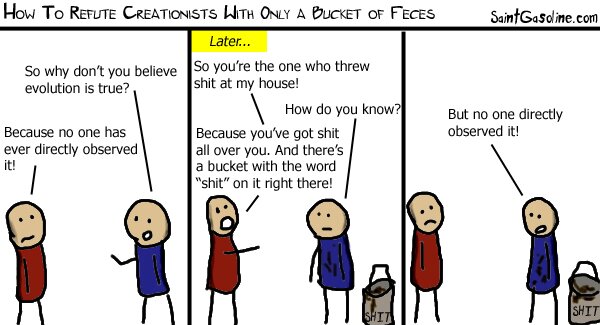

So I decided to read a lot of the published work on Kalam, both pro and con. I tried to put myself in the shoes of a believer and focus not on finding fault with the argument but on finding the best arguments for Kalam and finding the best responses to arguments against it. I think I was able to do a pretty good job of this, perhaps because I would have no problem believing in God if I actually thought there were solid arguments for his existence. It was a pretty weird experience though. After reading many of Craig’s responses to objections to the argument, whenever I read a new objection I would feel sure that Craig would have a good response. And sure enough, he did, or at least one that seemed good when you were predisposed in favor of Kalam. Eventually though, I came across serious objections that neither I nor Craig seemed to have good answers to. Fortunately for my chances in the debate, Craig had reasonable responses to many of the most common objections to Kalam.
Does the fact that Craig has good answers to some of the most common objections mean they are bad objections? Not necessarily. If someone does not provide any support for the premises of the Kalam argument, then a reasonable objection is to say that you haven’t seen any reason to think that either premise is true. If someone provides some arguments for the premises, but those arguments have flaws, it’s perfectly reasonable to point out those flaws. It may be possible for a theist to get around some of those flaws by making a more complex version of the argument that has new and different flaws, but that doesn’t make the original objections bad. However, I think it is a big mistake for people debating William Lane Craig to focus on the more basic objections. Craig can respond by quickly rebutting these objections and can then use the rest of his time to make even more arguments in favor of Kalam. That’s what I hoped to do in the debate, and I think this strategy was pretty successful.
So it’s important for anyone debating Kalam to not only know a lot of objections, but to know how a proponent of Kalam will likely respond. Since Kalam is one of the most popular arguments for the existence of God, I think that anyone wanting to debate the existence of God should have a good understanding of the arguments for Kalam.
I’m planning on doing a series of posts which will hopefully give people a better idea of what to expect when debating Kalam. But before I get into arguments against Kalam, I’m going to post the opening speech I prepared for the debate so you can see Kalam at its strongest (or at least my attempt to present it as strongly as possible). Here’s the speech:
The question of whether God exists is one of the most important questions we will ever have to answer. The decision we reach has the potential to not only affect how we live our lives, but what will happen to us after we die. For that reason, I think that all arguments for and against God’s existence should be exposed to intense scrutiny. My opponent tonight is an atheist writer and cartoonist who has previously written on, and debated, the Kalam cosmological argument. I expect him to have a long list of objections, which I will do my best to answer. I believe that the Kalam cosmological argument will withstand his criticisms, but you will have to judge that for yourselves.
The Kalam cosmological argument is actually remarkably simple. Its first premise is that everything that begins to exist has a cause. Its second premise is that the universe began to exist. Therefore, we conclude that the universe has a cause. This is a valid argument, which means that if the premises are true, the conclusion must be true. So an atheist must reject at least one of these premises if he wants to avoid believing that the universe had a creator.
I will begin by talking about why I think that the universe must have had a beginning. One argument in favor of this is as follows: Premise 1: An actual infinity cannot exist, Premise 2: an infinite temporal regress of events would be an actual infinity. Therefore an infinite temporal regress cannot occur. Something may be potentially infinite; you may be able to keep dividing it, or adding to it. But you can never reach the point where you actually have an infinite quantity of something. While the concept of an actual infinity can be expressed mathematically, as in Cantor’s system of transfinite arithmetic, mathematicians Kasner and Newman have noted that “’Existence’ in the mathematical sense is wholly different from the existence of objects in the physical world.” In the words of the influential mathematician David Hilbert, “The infinite is nowhere to be found in reality. It neither exists in nature nor provides a legitimate basis for rational thought… The role that remains for the infinite to play is solely that of an idea.”
For the existence of an actual infinity would have absurd consequences. Imagine a book whose first page is 1/2 inch thick, whose second page is 1/4 thick, etc. Although there is no last page, the book is of finite thickness and each page is still a finite number of pages away from the first page. Now take the book, close it, turn it over and lift up the back cover. There is nothing there to see! Now imagine trying to touch the last page. The problem is that after any page, there are infinitely more after it. So if you are able to touch any page at all, your hand must have somehow already penetrated infinitely many pages. This example demonstrates the absurdities inherent in having actual infinities exist in reality.
This point is further emphasized by the example of Hilbert’s Hotel. In a hotel of infinitely many rooms and with no vacancies, you could still find room for infinitely many new guests merely by shifting the current guests to the even numbered rooms and putting the new guests in the odd-numbered rooms (assigning the old guests to the rooms that are twice their old room number). And you could even have infinitely many guests check out (all those in odd numbered rooms) and still have a full hotel merely by shifting people to rooms that were half their old room number. But if the infinitely many guests that leave are all those in rooms numbered above 3, then the hotel would become virtually empty and there would be no way to shift the guests around to avoid this. Thus you can have the same number of people leave, and get radically different results. Can anyone genuinely believe that such an absurd hotel could exist in reality?!
And any infinite temporal regress must be an actual infinity because every event takes a certain amount of time, for an infinitely slow event would actually be a changeless state. Regardless of how long each event took, infinitely many events would have taken place given an infinite amount of time. Since an actual infinity cannot exist and an infinite temporal regress would be an actual infinity, the universe must have had a beginning.
There is also ample empirical evidence that the universe had a beginning. Over the last century, scientific discoveries such as cosmic microwave background radiation and the cosmological redshift have provided strong evidence in favor of the Big Bang model. We now know that the universe is expanding, and if you were to travel back in time, you would see the universe getting smaller and smaller. In the words of physicist P.C.W. Davies, “If we extrapolate this prediction to its extreme, we reach a point when all distances in the universe have shrunk to zero. An initial cosmological singularity therefore forms a past temporal extremity to the universe. …the big bang represents the creation event; the creation not only of all the matter and energy in the universe, but also of spacetime itself.” Under the Friedmann-Lemaitre model, which is the standard Big Bang model, matter and time originated ex nihilo a finite amount of time ago at the initial cosmological singularity. There have been countless attempts over the years to avoid the inescapable conclusion that the universe began to exist. The steady state model was proposed and then discarded. The oscillating universe model was proposed and then discarded. There have always been, and will continue to be, plenty of fanciful speculations, but none of them are realistic. Time does not permit me to explain the problems with every alternative ever conceived, but I would be happy to explain the problems I see with any alternatives that my opponent thinks are viable. Since there is no plausible way in which the universe could have existed for eternity and because of the strong philosophical arguments against a beginningless universe, we reach the conclusion that the universe began to exist.
Of course an atheist could still argue that maybe there’s some a-causal way in which the universe could have come about. To do this, he must argue that the entire universe just suddenly appeared for no reason whatsoever. But no one seriously believes that things like dogs and sports cars can just pop into existence without a cause. However, if things could come into existence from nothing, why just universes, why not airplanes, hamburgers and construction workers? Why is nothingness so discriminatory? How can there be some property of nothingness that favors universes, since nothingness has no properties? And believing that things do not need causal explanations would wreak havoc on the sciences. If scientists had simply assumed that things could appear uncaused out of nothing, there would not have been such a wealth of groundbreaking scientific discoveries over the last century. Scientists could always label something uncaused and never have to search for a causal explanation for it. We should be very careful not to cut off the search for explanations too soon.
While I do not think the universe could be eternal for the philosophical and scientific reasons I listed, if all my philosophical arguments turn out to be misguided and our current understanding of physics turns out to be merely a mythic narrative with no basis in reality, we should obviously reconsider. But barring this, I think we need to go with what seems like the only reasonable explanation, that some entity created the universe a finite amount of time ago.
Once we realize that there must be a creator of the universe, the next step is to try to figure out what properties this creator possesses. Since everything that begins to exist has a cause, we have (by contraposition) that the uncaused creator did not ever begin toexist. Since he is the creator of all matter, he must himself be immaterial. He must also be unbelievably powerful since he brought all matter, energy, and even space-time itself into existence without any material cause. There is also good reason to think that this cause is personal. There are two types of causal explanations: scientific explanations in terms of laws and initial conditions, and personal explanations in terms of someone’s will. For example, if you asked, “Why is the kettle boiling?”, I could say that heat from the burner is being conducted through the metal bottom of the kettle to the water, causing the water molecules to vibrate so violently that they break the surface tension of the water and escape in the form of steam, or I could say that I put the water on because I wanted some tea. In this case, both are legitimate explanations, though some people may look at me a little funny if I responded with the former. But with the universe, there cannot be a scientific explanation since there was no natural world before it came into being and therefore it cannot be accounted for by laws operating on initial conditions. So the most plausible explanation is in terms of an agent and their volitions. Therefore, we have good evidence for an uncaused personal creator of the universe who is beginningless, immaterial, and incredibly powerful. This is what we mean by God. Of course this does not prove that the Christian conception of God is correct while the Muslim one is false. For that we need to look at things like the historical evidence for Jesus’ resurrection, and the countless miracles that have taken place over the years. But if sound, the Kalam cosmological argument invalidates atheism. I urge you to carefully consider this argument, for the conclusions you reach tonight may have consequences far greater than you realize. Thank you.
